Sunday, December 28, 2014

Inner voices

There are certain inner voices we all share. There's one that lurks in the shower and plays back to us stupid things we have said at parties or other public gatherings--the little inner voice that makes us punch the shower-stall wall.

Another voice common to most of us starts to whisper just as we are finally getting hold of the first tendril of a good night's sleep. That voice tells us what we should have said, the clinching phrase that would have swayed the meeting to our side in the debate, silenced the bully, stifled the person telling racist jokes on the bus. So witty, so incisive...and so impossibly too late. And, of course, after that voice has spoken we are too annoyed with ourselves to go to sleep easily.

I have other inner voices that are more welcome, though. My dad died a few years ago; but he had throat cancer early and most of his voice died in 1963 as a by-product of the surgery that saved his life. He had a hearty whisper from then on, but not the remarkable, rich baritone he had had before the operation. When I was small and we all crammed into the car for family trips, he would sometimes sing to amuse us (when he wasn't making up cribbage hands from the letters and numbers on the license plates of the cars ahead of us). Sometimes if I sing "Bye, Bye, Blackbird" I can sort of hear him singing along with me. That's a precious inner voice.

And there are other inner voices that just plain puzzle me. Back before I moved from guitar to banjo, I used to play a lot of Renaissance pieces that had originally been composed for the lute. I have the remains of the music book I wore to tatters over many years of practicing that must have been a sad trial for anyone within range.

Adrian Denss wrote one of those pieces, a "ronde", in 1594. Here's a snippet of it:
I plucked away at this thing off and on for a week or so, and finally had the fingering worked out. Then, the first time I tried to play it through without pausing, a voice spoke in my head when I got to the measure I have put in a red rectangle. Between the little run and the chord, the voice said, "Wouldn't it have been better if, rather than trying to capture more of the enemy, they had figured out how to take care of those they had already captured?"

I don't know what it meant, or what it means. And, of course, after the first time, the words were there as if printed on the page whenever I played that piece and got to that measure.

Maybe that's why I moved over to banjo.

Wednesday, December 17, 2014

Back before computers

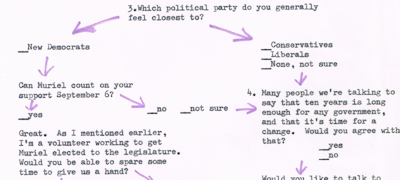
I was hunting through a file drawer for something else entirely, and came across an artifact from a political campaign from about thirty years back. It's a sort of script I developed for doing a phone or door-to-door survey of voters in the first canvass during an election.


I typed this thing out five or six times before I had it the way I wanted, and then got out what must have been a purple felt-tip to draw the flow arrows.

Nowadays, of course, I would just fire up Gliffy or one of its online design cousins and drag-n-drop until I had the flow I wanted, in a chart I could edit as needed. And then I could launch Apache Flex (or the technology of your choice) and build a little app for mobile devices to display the script in an interactive form so the campaign worker wouldn't have to struggle with clipboard and paper and the app could throw survey responses back to a central database.

Gestetner duplicator
Time to run off the newsletter!
But I'm glad I had the chance to write on a manual typewriter with correction fluid near to hand, to painstakingly carve text into a stencil and then run off copies of key documents on a Gestetner duplicator. Since it was so hard to correct something once it got typed or drawn, you learned to compose in your head to near-final quality, rather than just flinging words at the screen and editing afterwards. You might even write things out by hand with a pen and a pad of paper before turning to the typing machine.

I think having to do mental composition, and then the tactile exercise of forming the words in ink, before typing what others might see helped me think more clearly about what I was writing and why I was writing it. It also means I have an endless stock of boring pre-computer stories to stun younger people with.

Tuesday, December 16, 2014

Lost in the maps

I have been working on a fun freelance project for a UK company, Anquet. Part of my work has involved creating image maps off huge images of Britain, Scotland, and Wales. You can click on a sector on the image to download a detailed map of that sector.

sample map
The client just told me the first feature is live, so I went to check it out and am having fun both with the map and the company's downloadable app. Next time I'm in UK, I'll have this on my tablet.

One of the delights of the project was running into all sorts of obscure-to-me place names in the British Isles, names I had heard at some point in the past and filed without quite knowing where in the country they were. Some few I have visited, but the majority of these odd but old friends I know from historical novels and other sources.

Or, of course, from the Flanders and Swann song, "The Slow Train", made up of names of now-closed train stations across England:

woodcut of a railway worker

Sunday, December 14, 2014

Passionate

I've added "Passionate" to the short story page.

 I had a drive-by review of this story once. I had read/performed it as part of an evening of storytelling put together by Image Theater in Lowell, Massachusetts. The next day we were crossing the parking lot at a mall on our way to the grocery store. A car zoomed toward us and screeched to a halt, and the driver stuck his head out--it was a guy who had been at the show, an author of several books. "Loved that story, loved it!" he said. "New Yorker quality." Then he zoomed away.

Saturday, December 13, 2014

Short Story page

I've added a short story page that will have links to stories I have written and am happy with, but that for some reason have not had a lot of circulation.

As your Advent treat, the first story added is "Proper Tennis". I hope you enjoy it!

Freelance page updated

My adventures in freelance-land are continuing, and continuing happily. As soon as I can catch my breath after completing the current fascinating jobs I will share the fun with you.

In the meantime--one of my clients asked me for a detailed list of what writing services I offer, so I have updated my writer and editor page. Have a look!

Tuesday, December 9, 2014

Message management

image of many text balloons
To my mind there are a few key elements to a message or marketing strategy. In rough order of priority, the key elements are:

  1. Learn and listen to your audience before you speak. When you talk about what you find important, you have to connect it to what they find important.
  2. Provide the value proposition: a clear, deliverable message that says what you want to say in a way your audience can hear it. The value proposition should identify a pain point for your audience and explain how you, or what you offer, will help make the pain go away.
  3. Include a call to action (do this, contribute that). The action should be clear, do-able (“sign this petition” not “end injustice!”) and if possible make the audience member who acts feel good for having acted and more ready to act again.
  4. Persist, but don’t pester. For each audience there is an ideal frequency of communications so that each contact reinforces your message and strengthens your connection with that audience. Less than that, and you drop out of memory; more than that, and you are a stalker.
  5. Follow through (technical excellence, in that your communication should be of the highest quality you can achieve; timeliness, so you aren’t talking about stuff that’s going to happen so soon on the heels of you talking about it that your audience can’t react) and follow up. When people respond to your message (with a question, a suggestion, a contribution) you need to be ready to respond right back (with thanks, thoughtful response, suggestion of a way to become more active…). Keep a record of what you said, and what got a good (or a bad!) response.
  6. Maintain message discipline. Everyone should stay on-message, without sounding like echoes. If you get asked a tricky question, it may be to trick you into an exploitable answer. We don’t need to be the first hose at every fire--it’s often better to get the facts right and make sure what you’re going to say meshes what the campaign is saying, rather than flail in front of the microphones. If you’re not an official spokesperson but you must speak out, make clear you are speaking for yourself.

I started to write this some time back, as I became more and more concerned about the messaging by a group that is very important to me. The current leadership of that group seems to focus obsessively on maintaining message discipline, which is the least important element of them all. The focus, after all, should be on communicating, not on controlling. 

If you are truly communicating, you have to be open to surprises. If what you have to say is important, it will survive occasional errors in the way you say it.