Thursday, March 8, 2018

Open Screenplay: open, sesame!

I often wake up with the flake of a screenplay in the corner of my mind:
FADE IN
EXT. A CITY STREET - AFTERNOON
JOHN, 30's, worn down by the world, is leaning against the corner of a building in the downtown of Lowell, Massachusetts. He is watching a string of PEOPLE heading toward the annual FOLK FESTIVAL.
A MAN'S HAT, of the old-style detective sort, blows along the street and fetches up against his leg. He looks at it, then reaches down to pick it up.
MARGO (O.C.)
That's not your hat!
...
And there I am with the first seconds of a new script, and no idea what might happen in the next few seconds, or all away along to FADE OUT.
Open Screenplay logoI don't have to discard the new idea any more. I can take the fragments of what I have and post them as a new project in Open Screenplay. The wizard steps me through naming the new script, choosing a genre and making a stab at a logline. I can go on from there, listing locations and maybe some characters. And at any point I can throw the project open to the whole Open Screenplay community. Someone out there will be able to tell me who Margo is, and what's in the hat, and what will happen if John picks it up.
I find the Open Screenplay interface useful and focused, and the community thoughtful and able to come at scripts from angles I have never considered. I love the idea that all contributors share in the success of a script, if it ever gets produced.
Writers condemn themselves to lives of isolation and carpal tunnel problems. Working on projects in Open Screenplay can be a medicine for melancholy and a remedy for loneliness.

Friday, July 1, 2016

Cast of One

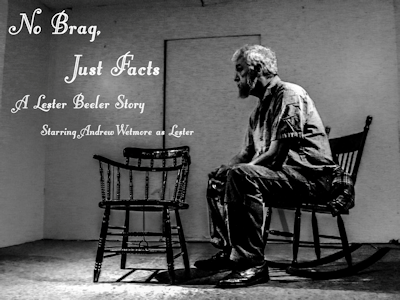
For the past year I have been involved in the world premiere of a play. Brenda Thompson wrote it from the memoirs of Lester Beeler, who lived most of the 20th century in the settlement of West Dalhousie, in behind Bridgetown, Nova Scotia on the top of the South Mountain. Brenda asked would I direct the thing and I said yes. And then we had a real problem finding an actor ready to take the play on and bring Lester to life.

It's a one-person play, essentially a 75-minute monologue. That's a lot of words, a lot of builds and dramatic pauses and snappy comebacks and tongue-twister lines. Not hard to see why local actors were reluctant to agree to play Lester.

So I said I would perform the play. And I have been doing it over and over again: being Lester in community halls and church halls and fire halls for audiences that often include people who have never ever been to a play before in their lives.

It's a long, long script. I had to break it down into scenes and beats to learn it, and then identify hooks I could remember to take me from the story that I had just finished to the one that was about to start. I met with members of Lester's family, to find out how he spoke and how he gestured. I borrowed a jacket from his grandson that was "just like" what Lester would have worn.

I gotta tell ya, the show is a hoot, and worth all the effort we've put into it. One of the greatest things is that, after the show, audience members share their own Lester stories--either stuff from their own lives that is just as funny and incredible as what I tell in the play, or actual stories in which the real Lester Beeler played a part. I particularly treasure the night when I finished telling the story about Old Joe and his truck, and the the day he gave Millie the schoolteacher a ride home and lost control of the truck and it and they ended up in the middle of a lake. As the final laughter faded down, a voice rang out: "That was my mother!" We had a good chat about Joe and Millie over tea after the show.

And now we get to take the play further afield. We are performing at the Fundy Fringe Festival in Saint John, New Brunswick August 16-21, and at the Atlantic Fringe Festival in Halifax, Nova Scotia September 1-11. It will be very interesting to see whether Lester's stories travel well beyond his home area, and whether the cast of one (me!) is up to the rigors of daily performances combined with handing out flyers and drumming audiences when I'm not on stage.

Another interesting challenge is the play runs about 75 minutes, but the fringe festival performance slots are 55 minutes (to allow setup time for the next act using the same venue). So Brenda and I have had the agonizing challenge of cutting 20 minutes of material out of a show without losing its spark and sparkle. To compound the challenge, the show is actually getting longer: Brenda is writing an additional scene about a "lost" episode in Lester's life, and that scene will meet its audience for the first time in West Dalhousie August 6.

And then I'll have ten days to unlearn it again.

Lester Beeler

Thursday, June 30, 2016

When you get to the final page

I have been writing the current play for far too long. The idea has been niggling at me for some years, and I made two or three false starts on it. But now I not only have a first draft of about 70 pages (not bad for something that at one point seemed likely never to make it to 10 pages): I even have a final scene.

That doesn't mean the play is ready for people to perform, or even ready for people to comprehend. I have a sense that the order of some scenes is wrong; that I have glossed over some stuff the audience needs to know; that at least one character's story line just fades out instead of coming to a good stopping point.

But now that I have the last scene, I know tons better what this play is actually about than I did when I started. And it's hardly about what I thought it was about, at all. I couldn't find the ending and couldn't find the ending, and the other day a character whom I had last seen about 20 pages earlier walked in and handed me the ending.

And now that I know better what the play is about, I can go back and spackle the awkward bits and expand the terse bits and get the thing to a point where some readers can sit around a room and read it to me. Here comes the fun stuff!

Getting to the end of a play gives you a gift that getting to the end of writing an article or an essay rarely provides: the characters have come alive and take the direction of the story out of your hands and show you how the play has to end even if it isn't how you thought it would end or wanted it to end. I think that's why I keep writing these things: there's a surprise at the end almost every single time.

Monday, April 18, 2016

Uncovering "coverage"

I wrote “coverage” of a screenplay for a new author, and it turned out to be a fairly good statement of my understanding of problems first draft usually encounter. So I have taken out specific references and am so bold as to share my thoughts with you here.

While there are some exciting events in this script, I think you need to do substantial surgery on it to create a compelling story that somebody would want to produce.

Writing a screenplay is tough because you have to engage and delight a whole bunch of different audiences, one after the other. These include:

  • Yourself: Is this a story you would watch if someone else had written it? Do you love the characters? Does the ending make you smile, or cry?
  • A reader: Studios and independent producers employ assistants to read scripts and evaluate them for possible production (what I am doing in this paper, in fact). They look for hooks—places to engage the audience—and also for odd things like the potential for product placement (if a key point in the scene has the hero shaving the beard he has always worn, maybe we can get a shaving-cream company to pay us to feature their product...). They think about whether the script takes advantage of trends (lots of room for another zombie movie!) or bucks the trends (I have never read a script before about a location scout who is a serial killer...), and other stuff out of the author's control, like whether the script is too similar to another script the studio has already optioned.
  • The producer: Can I make money off this, or convince investors that they will? How much will it cost to make? How would I pitch it? What is its category?
  • The director: Why would this be a fun script to work with. How would it stand out? What would be the memorable moments people would pirate and post on YouTube?
  • Actors: How will playing this character let me do something I have never had a chance to do before, or strengthen the bond between me and my fans?

Having to please a sequence of people who each apply a different lens to the script is one of the reasons it is so hard to get a script produced. A screenplay that tells a good story that is easy to summarize, with one or more prominent characters the reader can identify with or love to hate, and that offers some jolts of excitement and some surprises, has a better chance of getting produced than a script without those things.

There are at the moment problems of fact, problems of story-telling, and problems of structure. Here are some notes under each heading.

Problems of fact

In this section I identified some specific errors in the script, problems with procedure in the courtroom scene, statements by a politician that are too incorrect to qualify as rhetoric, and so on. Each script has these, and it often takes someone who is not the screenwriter to identify them.

Problems of story-telling

Story-telling includes drawing the audience in, giving them something or someone to care about, providing surprises and delights, and drawing all the threads together in a satisfactory way in the end.

  • What is the elevator pitch for this movie? An “elevator pitch” is what you would tell a potential producer while the two of you were going up in an elevator in a not-very-tall building. You have less than a minute to outline your story, give a little of its savor, and plant a hook so the producer wants to find out more. The ideal elevator pitch is a short sentence that forces the producer to ask more, not out of politeness but because it's interesting. Here's a pitch sentence for the first Star Wars movie (I guess really episode 4): “A young farm boy joins a princess in the Rebellion against the Galactic Empire.” And you wait for the producer to say, “And then what happens?”

    I have been trying to write a sample for you, but I have not yet succeeded. That is probably because of some of the following problems.
  • What is the story? Is it about a caper gone wrong? Is it about a father very ineptly trying to reconnect with his son? Is it about a second wife discovering her step-son might be a better partner than her current husband? The script starts with the caper and ends with the love story, and this may be a big reason it feels disjointed.
  • Who are we rooting for, and rooting against? Is this A's story? B's? C's?? These are the most likely characters to be either the hero or the villain, but I don't see any of them clearly enough yet. And if one of them is the hero, who is the villain that person is struggling with? The three main characters in your script seem to move mainly in parallel with each other, and are rarely in conflict, but they are not really allies—B, for instance, knows nothing about the money-laundering until quite late in the story.
  • Why are people doing what they do? Why did B (a young woman) marry C? Why is she now casting an eye at A (C's son by a previous marriage)? If C is so wealthy, why is he involved in this dubious scam? Why is the governor in on this—is it just about the money? Most of the schemers already seem to have a ton of money.
  • Twists: the only twist I see so far, and it's a good one, is that C is bringing A onto the scene not to redeem him, but to use him for criminal gain. The story would benefit from a couple more surprises like that.
  • The love story: I understand A being involved in the scam, but I don't see at all that he is interested in B, or why he would be interested; and since the story ends with the resolution of that line (he gets in her car and they drive away), I think the viewers need to see their developing relationship much more clearly. One classic way to deal with unlikely lovers is to start with them colliding, scrapping, misunderstanding each other. And in the effort to defeat this nasty person, each comes to discover that the nasty person is not so nasty after all, that in fact they are meant for each other.
  • Save the cat: Once you have figured out who your main villain is, have that person do some nice thing that shows he or she is more than a cardboard cutout in a shooting gallery. If the villain is also a Big Brother or a Big Sister, it makes the villain much more interesting, and also adds complications to the villainy.
  • Feet of clay: C is, I guess, a greedy liar; A is a thief, or at least an ex-thief. What is B's weakness? What is her character flaw, or what temptation does she succumb to? Just as the bad guys have to have tiny redeeming features, the hero characters cannot be perfect and flawless. And while we're on the subject, what are her good points? She seems too featureless, too perfect, to be the character we root for.

I would recommend that you look at each scene and figure out what each significant characters wants in that scene, and what they come away with. If you have a scene where what the characters want is not in conflict in some way, and that ends with characters neither gaining or losing their objective, that's a scene to be suspicious of. Scenes like that can work okay in a novel, because you can explore character, location, and relationships in depth; but they are hard to justify in a movie, where you only have a very few minutes and a very few pages to set the scene.

Every character, down to the foreman of the jury, has a character arc, a progression from stability at the very start of the story, through becoming unstable by their own actions or some event, struggling to gain some new stability in body and spirit, and either succeeding or failing. He or she starts in one place and usually ends in a different place. Ideally, the change is because the character acts in response to what has happened before, not just because things happen to the character who takes these things passively. I don't understand the character arcs for the main characters. You can have minor characters with flat arcs (the court clerk is just going about his business), but major characters need to have a character arc that drives them and that the audience can figure out.


Problems of structure

Just as each character has an arc, the whole screenplay needs a story arc. A traditional story arc goes something like this:

  • We set the scene and identify the main characters (the characters we identify with) who are balanced.
  • An event (earthquake!) or a character decision (kiss the boss's daughter) knocks the main characters off balance.
  • The main characters take steps to get back in balance (run away! Steal some money!! Elope!!!) and for a bit it looks like things are going to be all right.
  • Things get worse and worse, and the bad guys are closing in. Further efforts fail badly.
  • Things are as bad as they can get. The main character or characters is at a very low point.
  • There is one last chance and the main characters take it. This last chance is planted early in the story, so the audience says, “Oh, yes! He's a ventriloquist!! He can maybe throw his voice to confuse the gunman...” just around the same time the main character has this insight.
  • The last chance either succeeds or fails. The main characters reach a new stability (a new life together; a life in jail; death; happily or unhappily ever after). They may ride off into the sunset together.

I can't follow the story arc in your script very well. And because I can't see the arc, I don't see very many twists and turns in it.

  • Bechtel test: The Bechtel test is a way of seeing if women get a fair shake in a script. The rule of thumb is: is there a significant scene or conversation where two or more women talk about something essential to the story that does not involve relationships with men? B is, I believe, the only significant female character, so she seems a bit isolated.
  • Voice: Almost all the characters speak the same way. Everybody says “ok” and asks if other people are all right. I can't tell without checking who is saying what. You don't have to go all Charles-Dickens and give every character a catch-phrase; but the way a person speaks rises from who the character is (including their racial, regional, and educational background, and how upset or determined or scared he or she is), so each main character should speak in a way that is recognizably theirs. Additionally, most of the minor characters, especially in the later scenes, speak like police reports. It's pretty turgid.
  • Scene rhythm: There are a ton of scenes that take place around desks in offices, or over the phone. We sometimes go from one meeting directly to another, or from one intercut phone call to another. This squanders the rich visual opportunities of a movie over a novel, and also settles the story into a dull rhythm. There are almost no action sequences, and certainly few that break up the talk-talk-talk. B in the shower, and in A's bedroom, and A hitting his escort, are welcome exceptions.
  • We know that! There are many, many occasions when we watch character D tell character E something. Then character E goes and tells character F what we as the audience already saw and know. This gets tedious for the audience. Two rules of thumb:

  • Start the second scene with character F reacting to what E says (which is what D originally said), rather then when F hears the news.
  • If you really must have a person tell what the audience already saw or heard, have that character get it wrong, or try to twist it to his or her own advantage. The audience loves getting outraged at bad-guy liars and cheaters (and cheering for tricky good guys), and you make a strength for the script instead of a weakness.
  • Conclusion: At the end of the story C is up his neck in trouble, the money-launderers and possibly the governor are in trouble, and B and A are in a car together, evidently starting out toward a new life. I don't get how that new-life thing works exactly, since I have not seen a real change in their characters and have no real evidence of their affection for each other. B just running away is a stunning change for a person who, to this point, has seemed efficient and dutiful. It makes a certain visceral sense for these two to end up together, but in both practical terms and in terms of character (C, for example, has learned that crime gets him both money and the girl. This does not bode well for their future) it is not convincing. The conclusion feels like something the author is imposing, rather than something the characters are discovering.

Good news

I hope you didn't slit your wrists yet. This is a great first draft, and far better than many scripts I have worked on. I would not spend this time on it, or suggest that you do so much surgery on it, if it did not have the kernel of something very good at the center.

The script runs about 100 pages right now, which is about right. You gain a lot of space by cutting down repetitive reporting of what the audience already knows, and can use that space for building up the relationship between A and B, establishing the main characters better so you can throw them off-balance better, and inserting some action that takes us away from board-room tables and cell phones.
Again, this is a good first draft. The really interesting bit is what you do with it next, to get to a very good second draft.

Andrew

Thursday, April 16, 2015

wheePub

I have always wanted to publish things. When we were in the Arctic I created books with an unbreakable but ungovernable Gestetner duplicator, the kind for which you cut a stencil with what looks like a dentist's tool, affix the stencil on a drum, apply far too much ink, and feed the paper, sheet by sheet with one hand while you revolve the drum to print through the stencil with the other.

Later, I was the editor of not one, but two monthly newspapers. Layout involved printing out the columns of text to appear in the paper, and placeholder spaces for the images, and then crawling around (and on) the layout sheets spread out on the floor with a glue-stick or other affixer and trying to get the right columns in the right places, and all parallel with each other. Then I would trundle the layout sheets off to the printer, where the staff would try not to sigh to loudly while correcting my sillier misteaks mistakes.

Boy, is it easier now.

I just published the first of a half dozen or so collections of my plays as an eBook. I wanted to see what was involved in creating such a book, and was not averse to sharing some of my plays with the reading public. I read a couple of online guides about eBook publishing and then tried my hand at it. The result is available on Kindle, Kobo, the Barnes & Noble store, and lotsa other places.


For those playing along at home, I created the cover using Canva. I generally write scripts using Celtx, but the standard script format is designed for an 8.5 x 11 page. I therefore had to blow away all the formatting Celtx provided in its export-to-PDF option by dropping the text of each play into a text editor (EditPad Pro), copying out of the text editor into Libre Office (or Open Office or Word), and providing some basic formatting that would read clearly on any mobile device.

Then I uploaded the document to create the eBook in Smashwords, which not only has lovely book-creation tools but also delivers the result to most eBook markets except Kindle.

After that I took the epub version of the book that Smashwords had created and uploaded it to Amazon's Kindle Direct Publishing to create a Kindle version. The link for the image above goes to the Canadian Kindle store, but you can find the book easily in Amazon Kindle for many nations.

No one step is too onerous. I spent the most time (aside from writing the plays in the first place, d'oh) reformatting the scripts to make them readable on screens of many sizes.

I have three more collections ready to go, and a fourth on the horizon. I won't belabor you with the construction details every time I publish a book, you'll be happy to know. But I will tell you as each book becomes available.

Monday, April 13, 2015

World-building

I am at the same time writing two plays, a couple of choose-your-own-adventure games, and another thing that may turn into a book...or nothing at all. I tend to launch into projects as early as I can in order to let the characters inform me about what happens in the story, rather than me telling them. I often have a hope about how the story will turn out--and often the characters educate me on the way, and the story ends differently, and much better, than the way I had at first hoped it would.

This morning a question came up on a games forum I follow about creating the "world" for a game. The writer was daunted by the amount of work that seemed to be required before you could start the first sentence of the first page of the actual thing you wanted to write. Here's my response (I'm posting it here so I can find it again when I need to remind myself):

You can write a first draft of a game without knowing much about your main character's physical world, world-view, opportunities or threats. But to go beyond first-draft level you need to discover and articulate the world. 
Knowing the world of the story keeps you honest as a writer: it leads you to write about things the main character would be concerned with, not what is on your authorial agenda, and it helps you keep things believable. If there's a pirate attack--how come? What forces them to become pirates? If the main character finds treasure, whose was it and who else is trying to find it? If there's a love interest, do the social rules of the world make it easier or harder for the main character to pursue that person?

If creating a world seems daunting, then go ahead and write the first draft of the game against a blank backdrop. If it seems like fun and you want to make it a richer game that's fun to play, you will then be motivated to explore and define the world.
I was writing about making games, as you can see. But I think the observation is true for any sort of creative writing.

Sunday, March 8, 2015

Altogether too much fun

As you know, I do a lot of freelancing. I have enough work coming in that sometimes there is a bit more than I can handle, so on the oDesk job site I developed an agency of freelancers. There are five of us now, covering editing, graphic design, and voiceovers.

Partly for fun, and partly to show off what I can do using Moviestorm, I created this animation about our agency. I have had far too much fun (read: spent far too much time) on this, and so am releasing it into the world even though there are a couple of things I really, really should tweak just one more time. Or two more times.


Tuesday, February 24, 2015

The sun never sets

Was just reviewing the list of clients for whom I am writing these days, and decided to plot my editing empire on a map. The realm of Cottage 14 is in blue:

Where in the world are Cottage 14's clients?

Makes it fun (harrowing fun, but fun just the same) to check the inbox first thing in the morning and see what new task has come in from Moscow or the United Arab Emirates.

Sunday, February 22, 2015

Two kinds of writing

I am doing a lot of freelance editing these days, and many of my clients find me through a freelancing site called oDesk. I have worked with a bunch of freelance sites over the past decade or so, but am finding oDesk to be ahead of the pack in several ways: the jobs offered seem to match my skills pretty well, the contracting and payment processes are straightforward and--so far--I have not had a tiff with a client.

They let you add a link to a video in your profile, so I thought I would create one. I am not delighted with the technical quality, but the light glinting off my glasses at least partly conceals when I am reading my notes rather than looking into the camera.

The video is below. The burden of what I had to say is this:

Here's a thing I've learned about writing: it comes in two broad categories.

The smaller category is writing that calls attention to itself: if you're a playwright, a speechwriter, or maybe a marketing person, you sometimes want text that is tangy as lemons off the tree, words as rich as chocolate, phrases the reader wants to read again just for the delight of it.

This writing is a lot of fun to put together, but unless you do it right it can get a little tiresome. Think of a meal of nothing but chocolate...

And the larger category is writing that's a vehicle for the important information you want to deliver. You have a point to make, a process to explain, a product to describe. For this you want writing so clear and efficient that the reader hardly even notices it.

I'm good at both kinds of writing, either editing and improving what you'd already got, or creating new material to do what you need.

And, of course, I'm very good at the essentials that both kinds of writing require: correct grammar, no punctuation or spelling mistakes, the right word in the right place in the sentence.

Let me know about your writing project. I can help make it clearer, more effective, and more worthy of what you want to tell people.

My profile on oDesk is here. Drop by if you need some writing or editing help.


Friday, January 9, 2015

On the very first page

recent stage plays
I've been slowly adding samples of a whole bunch of my short plays to this blog, and in the course of that I have had the chance of pondering what makes a good first page.

Before the play is produced, you want a good first page or the director or producer reading it will never get to the second page. So from the point of view of text, the first page of a script has to:

  • be technically solid. The play has to be in a format the theater world recognizes and accepts; and of course there have to be no typos or grammatical face-plants to make the reader ask herself whether she wants to continue with this thing even one.more.page.
  • cast a spell. George Bernard Shaw prefaced some of his plays with technical notes or "directions" that ran into the hundreds of words and described all sorts of stuff that the characters did or experienced before they ever got to the stage. You cannot do that these days. Even GBS could not do that were he writing in these days. You have to start with a vision (a woman tied to a chair; a man in a bathrobe in a public place; two people joined around the forehead by a long rope) to get the reader to say, "Oh?" and possibly, "Oh!"
  • pose a problem. If the play starts with two people sitting on a couch, waiting for the pizza guy and bickering over the remote, and nothing beyond that happens by the bottom of the first page, I the reader will probably go on to the next play in the pile. I can get bickering at home, the potential director says, why should I have to read about it at work?
  • create an opening. While producers and directors want plays that are solid and pretty sure to "work", they also want to see where they can fit it. Where can they make this their production of your play? I try to do this by providing just enough stage directions ("A Ferris wheel in an amusement park") to excite the "Oh, how would I do that?" response, without telling them how I would.
Ah, but the first page of the play also has to work its magic when it gets produced. The audience in the theater doesn't care that the script is well-formatted. The audience wants to be magic-carpeted away by the theater experience, and the script has to make that possible starting from the very first page.

So, in addition to the bullets above, the first page of the script has to:

  • tune the audience's ear, so they know how to listen in this particular theater to this particular play. In a full-length musical you get an overture to tune the ear and set the tone; with a short play you get maybe three lines of dialog and MAYBE one sound effect before the audience starts to give up on listening and starts feeling around for candies wrapped in crackly cellophane..
  • catch the eye. The play can start with just an actor standing in a pool of light, but that actor had better be pretty interesting to look at or do something notable very soon, or the audience will think something went wrong with the rest of the lights.
  • show us the main character(s). In a longer work the main character might not even show up for a couple of scenes, to build up tension. In a short play, you don't have time for such tricks.
Set for a production of The Real Inspector Hound
In Tom Stoppard's "The Real Inspector Hound", two theater critics are watching a truly awful who-dunnit. The lights come up and--nothing happens. And nothing happens. One critic says, hopefully, "It's a pause." The other says, "You can't start with a pause! If you want my opinion there's total panic back there."

If you don't have a good first page, your audience will have the latter reaction every time.

A lot of the plays listed on my Stage plays page have links to their first pages. Take a look: let me know what has you looking for page 2 and what has you running for the exits.

Sunday, December 28, 2014

Inner voices

There are certain inner voices we all share. There's one that lurks in the shower and plays back to us stupid things we have said at parties or other public gatherings--the little inner voice that makes us punch the shower-stall wall.

Another voice common to most of us starts to whisper just as we are finally getting hold of the first tendril of a good night's sleep. That voice tells us what we should have said, the clinching phrase that would have swayed the meeting to our side in the debate, silenced the bully, stifled the person telling racist jokes on the bus. So witty, so incisive...and so impossibly too late. And, of course, after that voice has spoken we are too annoyed with ourselves to go to sleep easily.

I have other inner voices that are more welcome, though. My dad died a few years ago; but he had throat cancer early and most of his voice died in 1963 as a by-product of the surgery that saved his life. He had a hearty whisper from then on, but not the remarkable, rich baritone he had had before the operation. When I was small and we all crammed into the car for family trips, he would sometimes sing to amuse us (when he wasn't making up cribbage hands from the letters and numbers on the license plates of the cars ahead of us). Sometimes if I sing "Bye, Bye, Blackbird" I can sort of hear him singing along with me. That's a precious inner voice.

And there are other inner voices that just plain puzzle me. Back before I moved from guitar to banjo, I used to play a lot of Renaissance pieces that had originally been composed for the lute. I have the remains of the music book I wore to tatters over many years of practicing that must have been a sad trial for anyone within range.

Adrian Denss wrote one of those pieces, a "ronde", in 1594. Here's a snippet of it:
I plucked away at this thing off and on for a week or so, and finally had the fingering worked out. Then, the first time I tried to play it through without pausing, a voice spoke in my head when I got to the measure I have put in a red rectangle. Between the little run and the chord, the voice said, "Wouldn't it have been better if, rather than trying to capture more of the enemy, they had figured out how to take care of those they had already captured?"

I don't know what it meant, or what it means. And, of course, after the first time, the words were there as if printed on the page whenever I played that piece and got to that measure.

Maybe that's why I moved over to banjo.

Wednesday, December 17, 2014

Back before computers

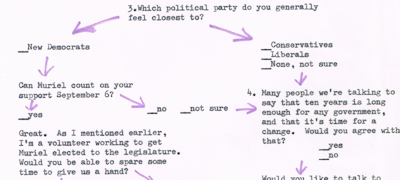
I was hunting through a file drawer for something else entirely, and came across an artifact from a political campaign from about thirty years back. It's a sort of script I developed for doing a phone or door-to-door survey of voters in the first canvass during an election.


I typed this thing out five or six times before I had it the way I wanted, and then got out what must have been a purple felt-tip to draw the flow arrows.

Nowadays, of course, I would just fire up Gliffy or one of its online design cousins and drag-n-drop until I had the flow I wanted, in a chart I could edit as needed. And then I could launch Apache Flex (or the technology of your choice) and build a little app for mobile devices to display the script in an interactive form so the campaign worker wouldn't have to struggle with clipboard and paper and the app could throw survey responses back to a central database.

Gestetner duplicator
Time to run off the newsletter!
But I'm glad I had the chance to write on a manual typewriter with correction fluid near to hand, to painstakingly carve text into a stencil and then run off copies of key documents on a Gestetner duplicator. Since it was so hard to correct something once it got typed or drawn, you learned to compose in your head to near-final quality, rather than just flinging words at the screen and editing afterwards. You might even write things out by hand with a pen and a pad of paper before turning to the typing machine.

I think having to do mental composition, and then the tactile exercise of forming the words in ink, before typing what others might see helped me think more clearly about what I was writing and why I was writing it. It also means I have an endless stock of boring pre-computer stories to stun younger people with.

Tuesday, December 16, 2014

Lost in the maps

I have been working on a fun freelance project for a UK company, Anquet. Part of my work has involved creating image maps off huge images of Britain, Scotland, and Wales. You can click on a sector on the image to download a detailed map of that sector.

sample map
The client just told me the first feature is live, so I went to check it out and am having fun both with the map and the company's downloadable app. Next time I'm in UK, I'll have this on my tablet.

One of the delights of the project was running into all sorts of obscure-to-me place names in the British Isles, names I had heard at some point in the past and filed without quite knowing where in the country they were. Some few I have visited, but the majority of these odd but old friends I know from historical novels and other sources.

Or, of course, from the Flanders and Swann song, "The Slow Train", made up of names of now-closed train stations across England:

woodcut of a railway worker

Sunday, December 14, 2014

Passionate

I've added "Passionate" to the short story page.

 I had a drive-by review of this story once. I had read/performed it as part of an evening of storytelling put together by Image Theater in Lowell, Massachusetts. The next day we were crossing the parking lot at a mall on our way to the grocery store. A car zoomed toward us and screeched to a halt, and the driver stuck his head out--it was a guy who had been at the show, an author of several books. "Loved that story, loved it!" he said. "New Yorker quality." Then he zoomed away.

Saturday, December 13, 2014

Short Story page

I've added a short story page that will have links to stories I have written and am happy with, but that for some reason have not had a lot of circulation.

As your Advent treat, the first story added is "Proper Tennis". I hope you enjoy it!

Freelance page updated

My adventures in freelance-land are continuing, and continuing happily. As soon as I can catch my breath after completing the current fascinating jobs I will share the fun with you.

In the meantime--one of my clients asked me for a detailed list of what writing services I offer, so I have updated my writer and editor page. Have a look!

Tuesday, December 9, 2014

Message management

image of many text balloons
To my mind there are a few key elements to a message or marketing strategy. In rough order of priority, the key elements are:

  1. Learn and listen to your audience before you speak. When you talk about what you find important, you have to connect it to what they find important.
  2. Provide the value proposition: a clear, deliverable message that says what you want to say in a way your audience can hear it. The value proposition should identify a pain point for your audience and explain how you, or what you offer, will help make the pain go away.
  3. Include a call to action (do this, contribute that). The action should be clear, do-able (“sign this petition” not “end injustice!”) and if possible make the audience member who acts feel good for having acted and more ready to act again.
  4. Persist, but don’t pester. For each audience there is an ideal frequency of communications so that each contact reinforces your message and strengthens your connection with that audience. Less than that, and you drop out of memory; more than that, and you are a stalker.
  5. Follow through (technical excellence, in that your communication should be of the highest quality you can achieve; timeliness, so you aren’t talking about stuff that’s going to happen so soon on the heels of you talking about it that your audience can’t react) and follow up. When people respond to your message (with a question, a suggestion, a contribution) you need to be ready to respond right back (with thanks, thoughtful response, suggestion of a way to become more active…). Keep a record of what you said, and what got a good (or a bad!) response.
  6. Maintain message discipline. Everyone should stay on-message, without sounding like echoes. If you get asked a tricky question, it may be to trick you into an exploitable answer. We don’t need to be the first hose at every fire--it’s often better to get the facts right and make sure what you’re going to say meshes what the campaign is saying, rather than flail in front of the microphones. If you’re not an official spokesperson but you must speak out, make clear you are speaking for yourself.

I started to write this some time back, as I became more and more concerned about the messaging by a group that is very important to me. The current leadership of that group seems to focus obsessively on maintaining message discipline, which is the least important element of them all. The focus, after all, should be on communicating, not on controlling. 

If you are truly communicating, you have to be open to surprises. If what you have to say is important, it will survive occasional errors in the way you say it.

Monday, December 8, 2014

Scribble, scribble

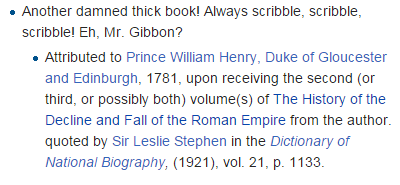
quote about writing
I have somewhere an unfinished screenplay about the life of a freelance writer. I hear you yawning already. But there was a very funny scene with the client who...well, I guess you had to be there.

I will say, though, that working for a wide range of clients and potential clients is super agility exercise for the brain. I am currently working on economic news for the Persian Gulf, business plans for a British company, a screenplay about a hit man with no head for finance, a study guide for those preparing for a standardized exam, and a children's book set in West Africa. I am in conversations about possible jobs with five or six other clients, and not one of the jobs matches any other that I am currently working on or trying to get.

Although I have spent years and years multi-tasking, I am by nature a bear of very little brain. I value being able to contemplate the task, or the task just done, for a little while to understand the full savor of it, rather than just churning along. But the consolation of extended freelancing is that it is never dull.

And there is no point trying to complete that screenplay. The website Clients from Hell catalogs the freelancer's life much better than I ever could.

Not that any of my own clients would ever, ever appear on that site...

Thursday, December 4, 2014

We're in Act 2B

Rose Schneiderman
A very wise person was just reading to me about Rose Schneiderman, a prominent labor leader in the US in the 20th century. She coined the phrase "bread and roses" to explain what the workers wanted. My wise friend read out from the Wikipedia entry, "Her platform had called for the construction of nonprofit housing for workers, improved neighborhood schools, publicly owned power utilities and staple food markets, and state-funded health and unemployment insurance for all Americans," and then said, "We're fighting the same battles she was a hundred years ago."

Some of the details have changed, but indeed this period is even more gilded than the Gilded Age, with the wealthy owning a bigger share than ever before and resenting the not-wealthy for owning anything at all. The "commons" of our shared assets as a people keep shrinking: as an example, the chairman of Nestle, one of the largest food companies in the world, is on record as saying that access to clean water is not a right.

I have to remind myself that the struggle for equity, for the greatest good possible for all people, is not a struggle against nothing, and it's not a struggle against what always must be. It's a struggle against well-financed interests who see nothing in common with average folks, much less with the truly poor and oppressed.

And I have to hope that we are in Act 2B.

What I mean is this: the classic movie follows a "three" act structure--really four acts of roughly equal length, but generally labeled 1, 2, 2B, and 3.
three act structure

  • In act 1 we see just enough of the hero's normal life to understand what he or she thinks is normal...and then the hero gets knocked off that stance by some event, intrusion, outrage, or opportunity. 
  • In act 2 the hero starts trying to get back into balance by beating the bad guys, rescuing the prince or princess, winning the race, finding the cure, diverting the meteor, or finding true love. This is sometimes called the "fun and games" act, where it looks like the plot will be foiled or the true love will become available, or the bad guys will be conquered.
  • Ah, but act 2b is when the bad guys roar back. The gains of act 2 turn into losses, the hero's best friend dies or turns out to be a traitor, the friendly wizard disappears, the starship runs out of fuel. The hero enters the long dark night of the soul when all seems to be lost--is there even any reason to keep trying?
  • Why yes, there is! It's act 3, where somehow the broken threads of the story get knotted together into a net that catches the bad guys, scores the winning goal, stops the auto-destruct with just two seconds to go, and brings the hero face-to-face with the one true love. The dark clouds scatter and the hero finds a new balance and a new understanding. Cue the credits.
The super-powerful and super-heartless have roared back from the "setbacks" of the New Deal and financial regulation and are doing everything they can to reduce the commons, restrict possibilities for all but the already-wealthy, and use up everything the earth has to offer in one orgy of converting the wonder that sustains us into dollars. This is grim and heart-rending.

And yet, act 3 is just around the corner. You, I, and all the other heroes of our multi-faceted movie need to make the effort to overcome adversity, confound the bad guys, and get to the happy ending.


How do we make that happen? I'm counting on you to help me figure it out.

banjo: this machine surrounds hate and forces it to surrender

Tuesday, December 2, 2014

Tidal chess ratings

chess board
I love chess rather more than chess loves me. I love playing the game as a relentless amateur, but I don't love it enough to do the sort of careful study that would lead me to any sort of mastery. When it comes to strategy, I am forever saying, like Otto in A Fish Called Wanda, "What was the part in the middle?"

Back before computers, I used to belong to the Canadian Correspondence Chess Association. We played chess by postcard, one move per card. A game of any decent length could take 18 months to play. I had a fancy folder of flat game boards with little flat pieces that could be stuck into place, to track the 20 or so interminable games I had going.

Now it is shiny modern times, and if I wanted, I could go online whenever I want and play lightning chess games where each player has a timebank of maybe two minutes. That is a bit fast for my brain, however.

For the past decade I have been playing most of my chess on a site with the fetching name of Red Hot Pawn, You can play casual games, join tournaments, or even be on a team in a league. I usually have 30 or so games going at any given time.

game history
I was looking over my game history, and I see I have won just a few more games than I have lost over this decade. This is reasonable, since as you win games your ratings improve, and they match you up with players with higher ratings than the players you were beating before. You get more ratings points when you beat a player who has a higher rating than you do, and fewer when you beat a lower-rated opponent.

But what has always puzzled me are the peaks and troughs--the winning streaks and the bleak weeks--of my game history. Over and over again I win a bunch of games and my rating climbs like the pitch of a roof, and then I go into a tailspin for five, eight, ten games. You would think the outcomes would be more evenly distributed, as at the left of the timeline, rather than clumping so much, so often:
chess ratings over time

Perhaps it is related to C.S Lewis' great insight in The Screwtape Letters about the Law of Undulation. As the senior devil in the book explains to the trainee devil:
Humans are amphibians—half spirit and half animal. (The Enemy’s determination to produce such a revolting hybrid was one of the things that determined Our Father to withdraw his support from Him.) As spirits they belong to the eternal world, but as animals they inhabit time. This means that while their spirit can be directed to an eternal object, their bodies, passions, and imaginations are in continual change, for to be in time means to change. Their nearest approach to constancy, therefore, is undulation—the repeated return to a level from which they repeatedly fall back, a series of troughs and peaks. If you had watched your patient carefully you would have seen this undulation in every department of his life—his interest in his work, his affection for his friends, his physical appetites, all go up and down. As long as he lives on earth periods of emotional and bodily richness and liveliness will alternate with periods of numbness and poverty. The dryness and dullness through which your patient is now going are not, as you fondly suppose, your workmanship; they are merely a natural phenomenon which will do us no good unless you make a good use of it.
Not sure how this insight helps me play better chess, but it helps me (a little bit) reconcile to my timeline.